
Family · Memory · Personal · relationships

The End In The Beginning

How do you know when a relationship has ended?  There are obvious moments: When one of you asks for a divorce.  When you realize that you are happier when you arrive home to an empty house.  When you stop caring about his opinion because it is always so negative, or critical, or judgemental.

But a hundred tiny moments come before those big moments. Some are identifiable landmarks.  Others are cumulative.

In my case, I began by putting the other person first.  Every time I chose myself instead, the relationship developed a crack.  Those small cracks waited for the bigger events to fissure and spread.

The first cracks and the first landmark evolved together.  While he was away at basic training, he wrote and sent a “Dear Jane” letter which he followed with a request to destroy it without reading it.  I did. A few months later, he proposed by phone.  I planned the wedding.  When he got home, he visited a childhood friend and cancelled the wedding – also by phone.  At the time, I was unaware of any connection.  I called it cold feet and panic. We were young.

A few days passed. Driving home with my parents, I simply knew he was at the house waiting.  I told them and, when we got there, he was.  My grandfather had refused to talk to him, so he was napping in his car.  I talked to him. I was 21 years old. I agreed to wear his ring and to keep talking. All this resulted in the wedding he planned and I flew to Louisiana for. He forgot a bouquet and none of my family or friends could attend.

He shaped the circumstances, but I was always the one who chose and acted. I wound up with the responsibility.

I didn’t have to forgive. I didn’t have to say, “Yes.” I didn’t have to leave home.
Family · Memory · Pets

Why a Fold? Beginning

During the pandemic I moved myself and my parrot Erin in with my mom. I teleworked from her location, 80 miles from my actual work. We joined her and her two Yorkies, Bear and Suzy.

We adjusted to circumscribed living and enjoyed their company, but Suzy had a heart condition and a tumor. She passed. We all missed her, but I began to think of getting a cat.

I’ve had three kittens in my life. My other cats were rescues or adoptions. Since Bear is older, I thought he’d find it easier to adjust to a kitten and might even bond with a baby. At first, I searched for adoptable kittens. I wanted kittens within 12-16 weeks and found none.

While I looked, I pulled out my books about cats and reread THE CAT WHO WENT TO PARIS series. I loved Norton the Scottish Fold then and now. I decided to look for breeders. The sticker shock was gigantic, but I found one who had kittens. Mom and I originally wanted two, but finally decided on one to be my focus while Bear remained hers.

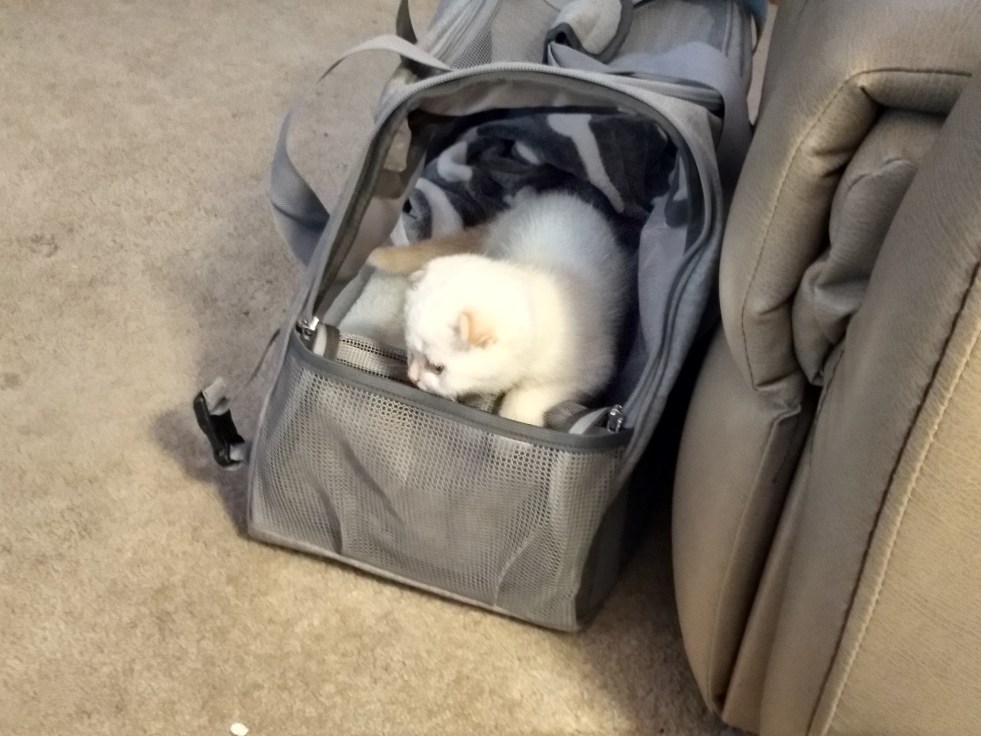
Bernie, the mildly disgruntled (after Bernie Sanders), was a hard sell. He was the next thing to indifferent to what I wanted, but he was also very mellow. He was unconcerned to be loaded into his soft carrier for an hour drive. He got a little noisy about half way and we stopped for a few minutes of reassurance.

I brought him home to his tent where had a small litter box, food, water, toys, a shag bed, toys and some blankets waiting. Bear was very interested and Bernie was simply mellow. Much of this behavior is typical of a Scottish Fold.

He is independent, curious determined, companionable but only sometimes cuddly. He chases and explores but doesn’t really climb much. He’s fastidious. He chose his litter robot over his litter box because it was cleaner. We have pee pads down for Bear and, if Bernie finds a used one, he carefully ruffles or folds it to cover and hide the spot. He finds it rude.

When he couldn’t convince Bear to be his friend, he settled for grumpy uncle and made friends with parrot Erin instead. Sleeping on top of her cage remains one of his favorite spots, but he quickly learned respect after she stripped the fur and some skin on half of one side of his kitten tail.

While I know this is cliche:. Bernie is the most dog like cat I’ve ever known. Moreover, he actually thinks about and orders his time. If the first try fails, he tries it another way. If he really wants something he will get it or do it eventually.

Family · History & Mission · Memory · Personal

Memory – A Story Interlude #1

How does a midlife crisis and a spiritual crisis tie together? In my case, they were sequential.

Huddled in my waterbed alone in a Fairbanks winter, I realized that I hated my job and had wound up where I’d vowed never to be. I’d done none of the things I’d planned to do and most of the ones that I’d sworn not to. I was married before 30. I was putting my husband’s needs and accomplishments first. I’d stopped writing. I hadn’t finished my college degree.

We were supposed to be living in Anchorage. We came to Fairbanks as a last minute change to my husband’s Army assignment. I brought my Pomeranian puppy, Corry, and a short work history with me. I felt uneasy spending money I didn’t earn and unable to put my own needs first, so I needed to work. We shared a single car, so we did a lot of coordinating and solo spontenaity was negligible. I was, essentially, dependent.

Being dependent was one of the biggest reasons that I’d sworn off marriage. To this day, I stand by this. If the Army hadn’t made it nearly impossible to be together unless married, we’d have stayed partners not spouses. My mom was 13 years old when she met my dad and his parents became her surrogates because hers were alcoholics. They married when she graduated from high school. She was 20 when I was born and 22 when my sister was born. She never got her driver’s license or worked after marriage.

Technically, that isn’t completely true. She got her license with me when I took driver’s training. She went to work at Montgomery Wards once my sister and I were both in our teens, but someone drove her to and from the Triangle Mall. Did I forget to mention? We lived next to my grandparents, Dad’s parents, and they joined us in our home after dinner just about every evening.

I loved it as a child. I had four adults available at all times. Mom got up each morning to see Dad off to work and then I went back o bed with her. We normally got up after we heard the school bus leave. The stop was right outside our house on the corner. If you discount my health issues, I had a picture perfect childhood. We were a little rural, so I played outside. My grandpa planted a garden. My grandma taught me how to crochet and knit. My dad taught me embroidery. I became the shared household baker. My mom taught me how to sew and was always trying new things with me. We always had pets, especially cats. My grandpa had chickens when I was young. He even caught and released a mama o’possum and her babies because I couldn’t let them be killed. He taught me to drive because Dad and I made one another too nervous.

As I got older, I saw how uneven these relationships were for my mom. Three other adults were always vetting her actions. Without money of her own, every purchase had to be approved. Dad paid all the bills, signing them after she wrote the checks. We all went grocery shopping together. Whenever she started acting too independent, she was brought up short. She was questioned about every moment she spend outside the house. She was discouraged from having friends beyond other couples, including spending too much time with any independent wives. More than once, I saw Dad reduce her to tears in social settings by belittling her, sometimes subtly and sometimes not.

As the oldest child and a girl, I fought for my freedoms and independence. As an adult, I intend to keep them.

Drugs · Family · Health · Pain Management

Get Over It (the Opioid Crisis) Already

My mom will turn 81 years old this July. She has been struggling without effective pain medication for over a year. Her OTC options are very limited because she is in Stage 4 kidney failure. She’s managed to stave off actual dialysis for nearly five years. She’s had one shoulder and one hip replaced and should probably have the remaining two replaced. But really at 81 years old?! She also has osteoarthritis, fibromyalgia, sciatica and spinal disk issues.

And she isn’t able to truly manage her pain … because the backlash from addiction to opiods has meant that the people who really need them often can’t get them. We resorted to buying edible cannibas (high CBD/low THC). She sleeps more to escape the pain and her energy is depleted from the stress of dealing with continuous chronic pain. She loved taking her Yorkie for a daily walk. She enjoyed going out to shop and eat, visiting the ocean etc. COVID limited that for such a long time that we were really looking forward to doing them again. And she just can’t cope without effective pain relief.

We figured something had happened to change policies at her PeaceHealth medical provider and recently had confirmed via an article in a local newspaper that one of the senior doctors (who just happened to be her doctor) was both over prescribing and prescribing for himself.

In the interim, her doctor recommended a drug that interfered with her muscle control and led to falls, shots directly into her joints and back, physical therapy and, of course, more surgery. Again, she is 80 years old. Quality of life is clearly more inportant than quantity at this point. She’d been taking Hydrocodone without overuse or addiction off and on for years. Getting addicted seems highly unlikely and, even if she did, why would it really matter?

She had a wellness exam with her doctor and I went into it armed for grizzly bears. We were not leaving without a plan that included a medication to manage her pain. Viola! The prescription had to be reviewed by a “team,” but we will be picking it up from the pharmacy tomorrow.

In conclusion, punishing people with a real need for pain management via opioids is WRONG. If some of those people no longer need the drug and/or get addictd, they need real treatment that is a viable alternative (maybe methodone), not to simply be cut off. Individuals become heroin addicts because heroin is cheaper then pills on the black market. And the need to get any of those things illegally, leads to crime annd broken lives. Treating the social issues that lead to addiction might also be a “good” idea.